Green Belt Policy
National Green Belt policy is changing and developers of land here will argue that the Green Belt falls into the lesser category of “grey belt”.
In planning terms land designated as Green Belt, including the land east of Coalpit Heath, serves five purposes:
a) to check the unrestricted sprawl of large built-up areas
b) to prevent neighbouring towns merging into one another
c) to assist in safeguarding the countryside from encroachment
d) to preserve the setting and special character of historic towns
e) to assist in urban regeneration, by encouraging the recycling of derelict and other urban land
Green Belt land is protected in planning legislation by requiring developers to demonstrate “very special circumstances” why it should be developed, and that those circumstances should outweigh the harm caused by the development.
Recently however, the Government has introduced the concept of “grey belt”, seemingly in an attempt to make development easier for housebuilders.
They did so by revising the National Planning Policy Framework (NPPF). The revised NPPF, in paragraph 143, is clear that the five purposes of the Green Belt (above) remain unchanged but, since the revision, it now goes on to claim that "grey belt" is "land in the Green Belt comprising previously developed land and/or any other land that, in either case, does not strongly contribute to any of purposes a, b, or d".
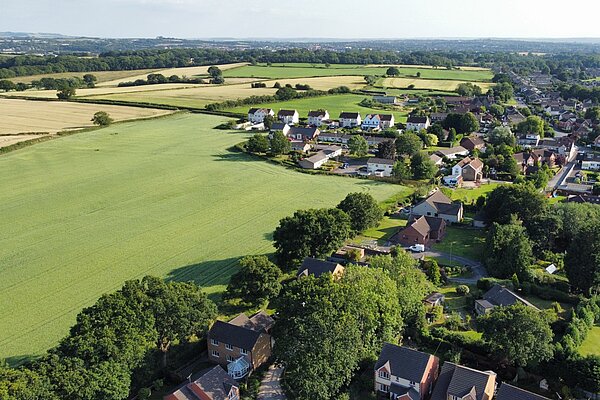
Therefore when looking at development sites developers will now ignore purposes c and e. As we can also agree that the Green Belt around Frog Lane is not “previously developed”, only the purposes that are to do with the size of existing developments remain:
a) to check the unrestricted sprawl of large built-up areas;
b) to prevent neighbouring towns merging into one another;
d) to preserve the setting and special character of historic towns
The accompanying planning guidance is clear that the purposes absolutely relate to large built-up areas and towns - and specifically not to villages. The 2022 West of England Combined Authority (WECA) Green Belt Strategic Assessment is clear that Coalpit Heath is not a town for Green Belt purposes, so arguments that the Green Belt here prevents Coalpit Heath merging with Yate will likely be ineffective.
But there is an argument that can be made:
The same WECA Green Belt Strategic Assessment confirms that both Bristol and Yate are towns for Green Belt purposes. Therefore:
The land east of Coalpit Heath contributes strongly to purpose b: It prevents the Green Belt towns of Bristol and Yate from merging into each other.
In addition to this it is reasonable to consider the existing contiguous development of Coalpit Heath, Frampton Cotterell and Winterbourne as a town. Indeed, in her objection to the Roundways application, Claire Young MP writes,
“Coalpit Heath, however, is not a regular village. It forms part of a trio of conjoined commuter villages - Coalpit Heath, Frampton Cotterell & Winterbourne - that effectively function as a single, large dormitory settlement on the outskirts of the suburban fringes of Bristol.”
If this is accepted then an additional argument follows:
The land east of Coalpit Heath contributes strongly to purpose b: It prevents the Green Belt large dormitory settlement of Coalpit Heath, Frampton Cotterell and Winterbourne from merging with the Green Belt town of Yate.
Published & promoted by South Gloucestershire Liberal Democrats, 63 Broad St, Chipping Sodbury, Bristol, BS37 6AD.